By the ChowChow Labs editorial team · Updated October 22, 2026 · How we check our content
The short answer: In Ontario, a sign’s shape and colour tell you what kind of message it is. Red means stop, yield or not allowed. Yellow diamonds warn of a hazard. Orange diamonds mark temporary conditions such as road work. Green signs guide you to places. Learn these groups and you can answer many sign questions even when the symbol is new to you.
Shapes and colours at a glance
| What you see | What it means |
|---|---|
| Red octagon (eight sides) | Stop sign. No other sign uses this shape. |
| Triangle pointing down, red border | Yield. Give way to traffic in or near the intersection. |
| White rectangle with black or red | Regulatory: a rule you must obey, such as a speed limit, a turn ban or parking rules. |
| Red circle with a slash | The action shown is not allowed. |
| Yellow diamond | Warning of a hazard or change ahead, such as a curve, a hill or a stop sign. |
| Orange diamond | Temporary condition, usually construction. Expect lower speeds and workers. |
| Five-sided, fluorescent yellow-green | School zone or school crossing. |
| Green rectangle | Guide sign: directions and distances. |
| Blue or brown | Services (such as hospitals or fuel) and tourist attractions. |
Regulatory signs: rules you must follow
Regulatory signs give an order. Breaking one can mean a ticket and, for some, demerit points. A tab underneath can limit when the rule applies, for example “7–9 a.m.” under a no-left-turn sign.
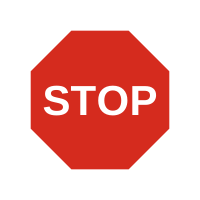 StopEight sides, red. Stop completely, then go when it’s clear.
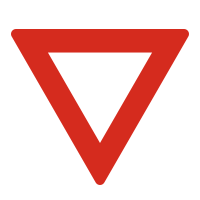 YieldTriangle, point down. Let others go first; stop only if needed.
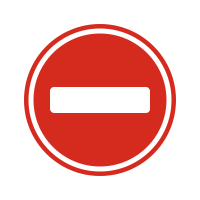 Do not enterYou may not drive onto this road or ramp.
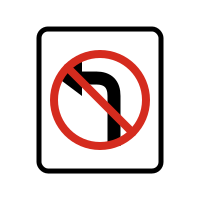 No left turnRed circle and slash: the action shown is not allowed.
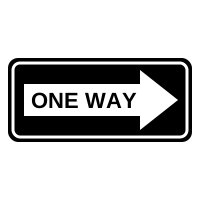 One wayAll traffic moves in the arrow’s direction.
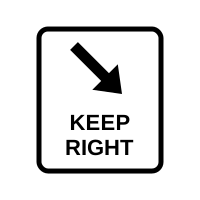 Keep rightPass to the right of the island or obstruction.
Warning signs: something is coming up
Warning signs don’t give an order, but the test expects you to react: slow down, look further ahead and get ready to stop or steer. A small speed tab under a curve sign is the highest safe speed in good conditions, so go slower when it’s wet, icy or dark.
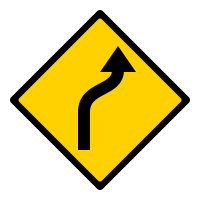 Curve aheadYellow diamond: a hazard or change is coming.
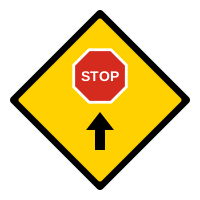 Stop sign aheadStart slowing now; the stop sign may be hidden.
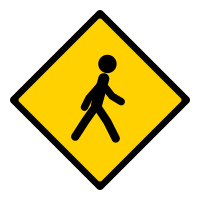 Pedestrians aheadBe ready to share the road with people walking.
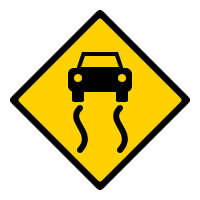 Slippery when wetSlow down and avoid sudden moves in rain.
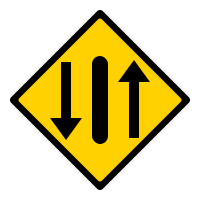 Divided highway beginsKeep to the right-hand roadway.
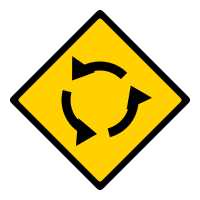 Roundabout aheadSlow down; traffic circles counter-clockwise.
School, construction, guide and other signs
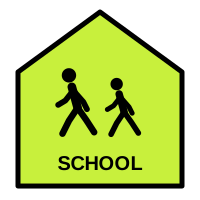 School zoneFive sides, yellow-green. Slow down, watch for children.
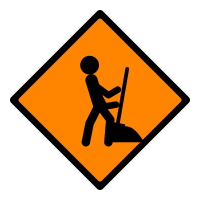 Road workOrange diamond: a temporary condition. Fines can double.
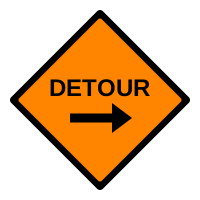 DetourFollow the detour markers back to your route.
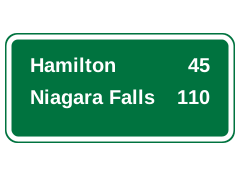 Guide signGreen: destinations and distances in kilometres.
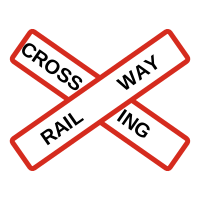 Railway crossingWhite X with a red border. Slow down and look both ways.
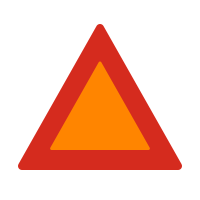 Slow-moving vehicleOn the back of vehicles going 40 km/h or less.
Signs people mix up
- No stopping, no standing and no parking. No stopping means you can’t stop at all, even briefly. No standing lets you stop only to pick up or drop off passengers. No parking also lets you stop to load or unload goods.
- Yellow diamond vs orange diamond. Same shape, different meaning: yellow is a permanent warning, orange is a temporary condition like road work.
- Pedestrian crossover vs crosswalk. A crossover has its own sign, often overhead lights, and an X painted in each lane. You must stop and wait until the person has crossed the whole road, not just your half.
- Stop sign vs stop-ahead sign. The red octagon means stop here. A yellow diamond showing a small stop symbol only warns that a stop sign is coming.
- Railway crossing sign vs advance warning. The white X-shaped sign marks the crossing itself, and a yellow advance warning sign may come before it. If a train is coming, stop at least 5 metres from the nearest rail or gate.
Official source
The full set of signs, including less common ones, is in the Signs section of the MTO Driver’s Handbook. Signals and pavement markings have their own sections: traffic lights and pavement markings. Checked October 2026.
Check yourself
Try these 8 questions from our free mock exams, then tap Show answer. For more, take the full road signs practice test.
Question 1 · Traffic Signs
You approach this sign at an intersection. What must you do?
- A. Slow down and continue
- B. Come to a complete stop
- C. Stop only if another vehicle is approaching
- D. Honk and proceed
Show answer
Answer: B. Come to a complete stop
A stop sign requires you to come to a complete stop.
Question 2 · Traffic Signs
What does this sign require you to do?
- A. Always come to a complete stop
- B. Speed up before entering the intersection
- C. Give way to other vehicles, stopping only if you need to
- D. Proceed without checking for traffic
Show answer
Answer: C. Give way to other vehicles, stopping only if you need to
A yield sign tells you to give way to others. You only stop when that is needed to let them through.
Question 3 · Traffic Signs
What does this sign mean?
- A. You must stop here
- B. A traffic light is ahead
- C. The road ends ahead
- D. Prepare to stop; a stop sign is coming up
Show answer
Answer: D. Prepare to stop; a stop sign is coming up
This is an advance warning of a stop sign, so reduce speed in good time.
Question 4 · Traffic Signs
What do warning signs like this one usually look like?
- A. Octagons with red fill
- B. Yellow diamonds with black symbols or lettering
- C. Green rectangles
- D. Blue circles
Show answer
Answer: B. Yellow diamonds with black symbols or lettering
Yellow diamond signs with black markings alert you to hazards ahead.
Question 5 · Traffic Signs
What does this sign mean?
- A. Road is closed in wet weather
- B. Wet pavement is being repaired
- C. Use high beams when it rains
- D. The road gets slick when wet, so reduce speed and take extra care
Show answer
Answer: D. The road gets slick when wet, so reduce speed and take extra care
This sign warns of a slippery surface in wet conditions.
Question 6 · Traffic Signs
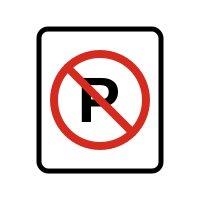
What does this sign mean?
- A. You may stop only briefly to pick up or drop off people or goods
- B. May not stop even for a moment
- C. May park for up to one hour
- D. May park only at night
Show answer
Answer: A. You may stop only briefly to pick up or drop off people or goods
The sign allows brief stops for loading passengers or goods, but not leaving the vehicle parked.
Question 7 · Traffic Signs
A sign like this one, found near road construction, tells you to:
- A. Speed up to get through quickly
- B. Take more care than usual and expect the speed limit to drop
- C. Stop and wait for permission to enter
- D. Pass any slow vehicles ahead
Show answer
Answer: B. Take more care than usual and expect the speed limit to drop
The sign tells you work is ahead; stay alert and expect to slow down.
Question 8 · Traffic Signs
This orange triangle with a red border on the back of a vehicle means the vehicle:
- A. Moves at no more than 40 km/h
- B. Is carrying dangerous goods
- C. Is an emergency vehicle
- D. Is a school bus
Show answer
Answer: A. Moves at no more than 40 km/h
The orange triangle warns that the vehicle is slow and will not exceed 40 km/h.
Next: Right-of-way rules. Who goes first at all-way stops, uncontrolled intersections, left turns and roundabouts, with diagrams.