Ontario G1 Practice Mock Exam 7
All 20 questions from Mock Exam 7, with answers and explanations.
A mixed exam like the real test: 10 questions on signs, lights and markings (8 with pictures) and 10 on the rules of the road, including turning & lane changes, alcohol & drugs and demerit points & suspensions.
These are the 20 questions from Mock Exam 7, covering road signs and the rules of the road from the official MTO Driver’s Handbook. Read through them with Show answer, or take the exam online first with the answers hidden and see your score. No sign-in needed.
Every question links to the section of the official MTO Driver’s Handbook it comes from. Questions were last reviewed in October 2026; read how we write and check them.
Question 1 · Traffic Signs
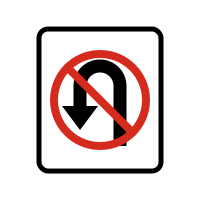
What does this sign mean?
- A. No left turns
- B. No right turns
- C. U-turns permitted when the road is clear
- D. Do not turn to go in the opposite direction
Show answer
Answer: D. Do not turn to go in the opposite direction
This sign prohibits turning around to head back the way you came.
Question 2 · Traffic Lights
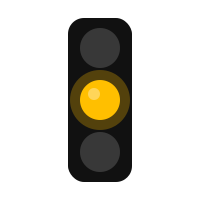
What does this signal mean?
- A. Speed up to clear the intersection
- B. Red is about to show; brake to a halt when you safely can, otherwise continue carefully
- C. The light is about to turn green
- D. Always stop immediately
Show answer
Answer: B. Red is about to show; brake to a halt when you safely can, otherwise continue carefully
Yellow warns that red comes next. Stop if it is safe to; if not, carry on through with care.
Question 3 · Traffic Signs
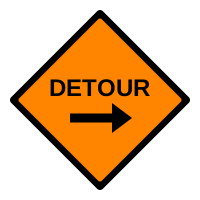
An orange sign shaped like a diamond, like this one, is mostly used to warn about:
- A. A short-term situation such as road work
- B. A permanent school zone
- C. A tourist attraction
- D. A change in the speed limit only
Show answer
Answer: A. A short-term situation such as road work
Orange warning signs mark conditions that are only in place for a while, for example roadworks.
Question 4 · Right-of-Way
Two vehicles arrive from different roads at the same moment at an intersection with no signs or signals. Which goes first?
- A. The vehicle on the left
- B. The vehicle on the right
- C. The larger vehicle
- D. The faster vehicle
Show answer
Answer: B. The vehicle on the right
Yield to the vehicle approaching from your right.
Question 5 · Traffic Signs
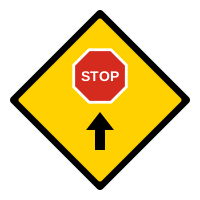
What does this sign mean?
- A. You must stop here
- B. A traffic light is ahead
- C. The road ends ahead
- D. Prepare to stop; a stop sign is coming up
Show answer
Answer: D. Prepare to stop; a stop sign is coming up
This is an advance warning of a stop sign, so reduce speed in good time.
Question 6 · Traffic Signs
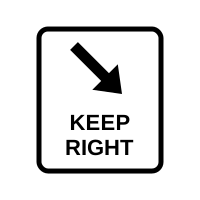
What does this sign tell drivers on a road with several lanes in one direction?
- A. Everyone has to turn right
- B. Slower vehicles belong in the right lane
- C. The right lane is for overtaking
- D. Right turns are prohibited
Show answer
Answer: B. Slower vehicles belong in the right lane
Vehicles travelling slowly should stay in the right-hand lane where there are multiple lanes.
Question 7 · Traffic Lights
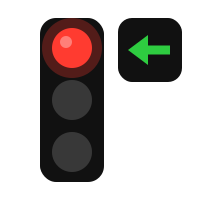
The traffic signal looks like this. You may:
- A. Proceed straight
- B. Turn right from any lane
- C. Turn left, using the left-turn lane
- D. Make a U-turn from any lane
Show answer
Answer: C. Turn left, using the left-turn lane
This arrow lets you make your left turn out of the dedicated left-turn lane.
Question 8 · Traffic Signs
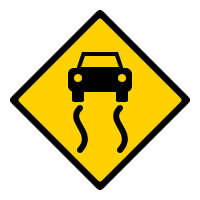
When does the warning on this sign matter most?
- A. Only for big trucks
- B. When the road is wet
- C. When it is dark out
- D. Only in the winter
Show answer
Answer: B. When the road is wet
This sign warns that the road is slippery when wet, so slow down and avoid sudden steering or braking in rain.
Question 9 · Pavement Markings
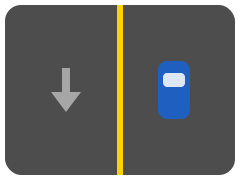
It is foggy and you are behind a slow vehicle. The centre line on your side is solid. What should you do?
- A. Stay behind it; passing here is not safe
- B. Pass it, since slow vehicles are a hazard
- C. Pass only after switching to high beams
- D. Pass it carefully using the right shoulder
Show answer
Answer: A. Stay behind it; passing here is not safe
A solid line on your side means passing is not safe. In fog you shouldn't pass at all.
Question 10 · G1 Licence Rules
What is the minimum amount of time you must hold a Level Two (G2) licence?
- A. 6 months
- B. 8 months
- C. 24 months
- D. 12 months
Show answer
Answer: D. 12 months
Level Two lasts a minimum of 12 months.
Question 11 · Night & Weather Driving
In fog, what should you use as a guide to stay in your lane?
- A. The centre line
- B. The tail lights of the vehicle ahead, following closely
- C. The right edge of the road
- D. Your GPS map
Show answer
Answer: C. The right edge of the road
Follow the right-hand edge of the road. Using the centre line as a guide can pull you toward oncoming traffic.
Question 12 · Alcohol & Drugs
Under Ontario's rules, a driver aged 20 with a full G licence is found with a small amount of alcohol in their blood. What happens at the roadside?
- A. Nothing, because they hold a full licence
- B. A 24-hour licence suspension
- C. A warning letter
- D. A 90-day suspension
Show answer
Answer: B. A 24-hour licence suspension
Drivers 21 and under must have zero blood alcohol, whatever their licence. Any alcohol brings an immediate roadside suspension, and a conviction adds a fine and at least a 30-day suspension.
Question 13 · Parking
What is the minimum distance from a bridge you must keep when parking?
- A. 15 metres
- B. 30 metres
- C. 50 metres
- D. 100 metres
Show answer
Answer: D. 100 metres
Don't park on or within 100 metres of a bridge.
Question 14 · Turning & Lane Changes
Where is a three-point turn NOT allowed?
- A. On a road with parked cars
- B. On any two-lane road
- C. On a curve or near a hilltop
- D. On a quiet residential street
Show answer
Answer: C. On a curve or near a hilltop
Three-point turns and U-turns are off-limits wherever your view is blocked: on curves, close to hilltops or railway tracks, and by bridges or tunnels.
Question 15 · Seatbelts & Safety
A child is 7 years old, weighs 30 kg and is 135 cm tall, and has outgrown a forward-facing seat. What restraint is required?
- A. A booster seat with a lap-and-shoulder belt
- B. A forward-facing seat with a tether strap
- C. A rear-facing seat in the back seat
- D. The vehicle's seatbelt on its own
Show answer
Answer: A. A booster seat with a lap-and-shoulder belt
Children under 8 who weigh 18 to under 36 kg and are under 145 cm tall must use a booster seat, which must be used with a lap-and-shoulder belt, never a lap belt alone.
Question 16 · Traffic Signs
A sign shows a square with a yellow-and-black checkerboard border around an arrow. What does it warn?
- A. A school zone just ahead
- B. A marked bicycle route
- C. A sharp turn; slow right down
- D. A railway crossing ahead
Show answer
Answer: C. A sharp turn; slow right down
A checkerboard border on a turn sign warns of a sharp turn and danger, so slow down a lot.
Question 17 · Pavement Markings
What does a shared-lane marking (a bicycle symbol with two chevrons painted in the lane) tell you?
- A. Cyclists and drivers share this lane
- B. Bicycles are banned from this lane
- C. This lane is a parking lane
- D. Cyclists must use the sidewalk
Show answer
Answer: A. Cyclists and drivers share this lane
Sharrows mark a lane that cyclists and drivers share. Expect cyclists in the lane and give them room.
Question 18 · Turning & Lane Changes
When is passing on the paved right shoulder of a road allowed?
- A. Whenever traffic in your lane is slow
- B. Only to pass a vehicle that is turning left
- C. To get to an exit sooner
- D. Never under any circumstances
Show answer
Answer: B. Only to pass a vehicle that is turning left
You may use a paved right shoulder only to get around a vehicle turning left. Never pass on the left shoulder.
Question 19 · Sharing the Road
You see a private vehicle with a flashing green light approaching. What does it mean?
- A. A slow-moving farm or road vehicle
- B. A driving school car with a student
- C. A volunteer firefighter or medical responder
- D. A police officer in an unmarked car
Show answer
Answer: C. A volunteer firefighter or medical responder
Flashing green lights are used by volunteer firefighters and medical responders in their own vehicles. Yield to help them get through.
Question 20 · Demerit Points & Suspensions
Which offence carries 7 demerit points?
- A. Driving 50 km/h or more over the limit
- B. Careless driving
- C. Racing
- D. Failing to stop for police
Show answer
Answer: D. Failing to stop for police
Failing to stop for police and failing to remain at the scene of a collision are 7-point offences. Racing, driving 50 or more over and careless driving are 6.
Ready to test yourself?
Take a 20-question practice exam with the answers hidden. You get a score using the real test’s 80% pass mark and an explanation for every answer. The real G1 knowledge test is longer and is split into a signs section and a rules section; see what’s on the G1 test.
More free practice and lessons
- Free G1 practice test
- Road signs practice test
- Rules of the road practice test
- Ontario G1 Practice Mock Exam 1 with answers
- Ontario G1 Practice Mock Exam 2 with answers
- Ontario G1 Practice Mock Exam 3 with answers
- Ontario G1 Practice Mock Exam 4 with answers
- Ontario G1 Practice Mock Exam 5 with answers
- Ontario G1 Practice Mock Exam 6 with answers
- Road signs by shape and colour
- Right-of-way rules
- Demerit points and suspensions
- G1 rules and restrictions
- What’s on the G1 test
- 7-day G1 study plan
- G1 test tips